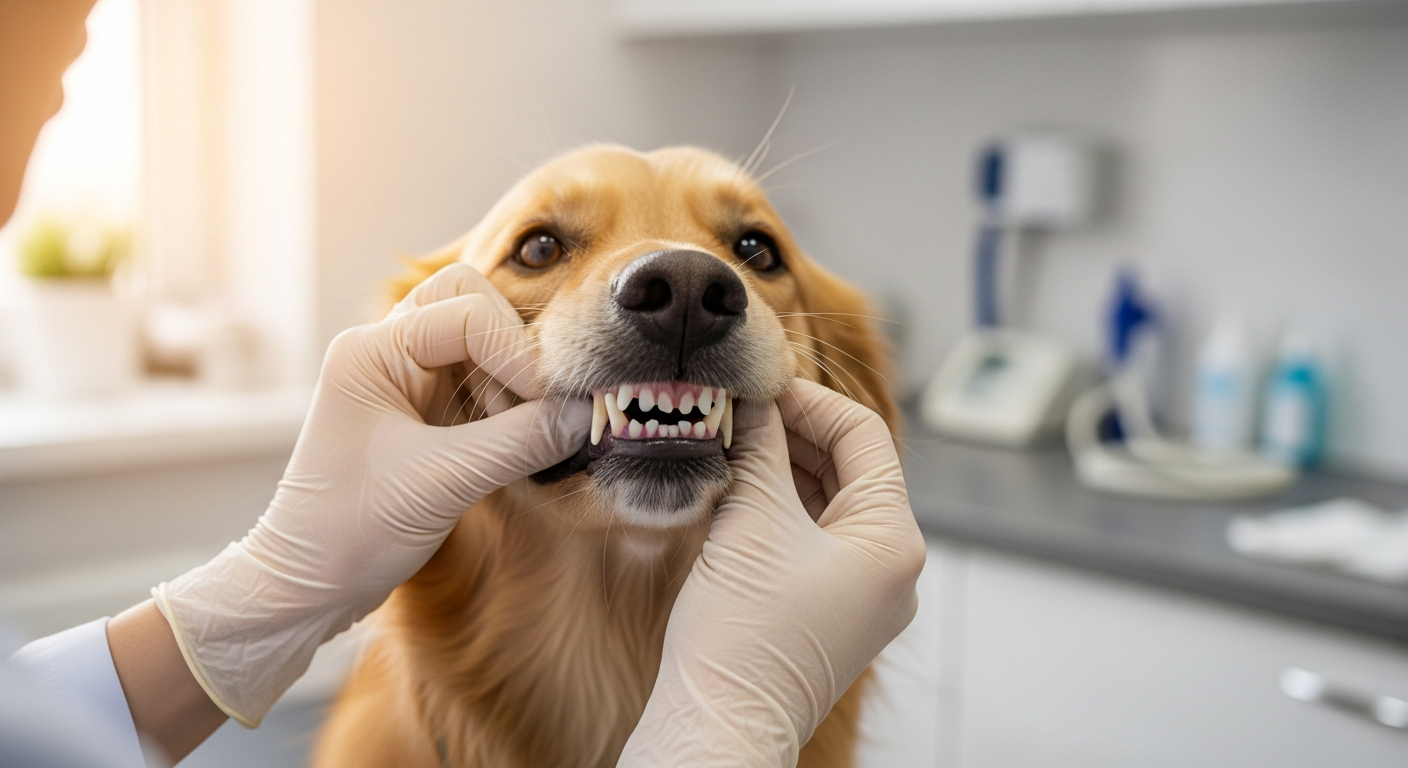
If you asked most owners to name the most common disease in adult dogs and cats, few would say dental disease. Yet that is exactly what the evidence shows. The American Veterinary Medical Association describes periodontal disease as the most common dental condition in dogs and cats, and notes that by age three most pets already have some early evidence of it [1]. Broader veterinary literature puts the figures higher still — on the order of 80% of dogs and around 70% of cats affected by early adulthood — and, critically, describes the disease as largely preventable [2][3].
Two facts sit uncomfortably together there: it is nearly universal, and it is largely avoidable. The reason for the gap is that dental disease is largely invisible. The damage happens below the gumline, out of sight, and pets are remarkably good at hiding oral pain. By the time an owner notices, the disease is often advanced. This guide explains what periodontal disease actually is, why it threatens far more than teeth, and the specific, evidence-based steps that prevent it.
What periodontal disease really is
It starts within hours of a cleaning. Bacteria in the mouth form a sticky film — plaque — over the teeth. If plaque isn't removed, minerals in saliva harden it into tartar (calculus) within days. Tartar creeps below the gumline, where bacteria trigger inflammation of the gums (gingivitis) — the early, reversible stage.
Left unchecked, that inflammation progresses to periodontitis: the structures anchoring the tooth — ligament and bone — begin to break down. This stage is not reversible. Teeth loosen, painful pockets form, and the infection has a direct route into the bloodstream. Veterinary dentistry grades this progression on a 0–4 scale (the AVDC periodontal classification), from a clean mouth (Grade 0) through gingivitis (Grade 1) to advanced bone loss (Grade 4) [2].
Why it's not "just teeth"
This is the part owners underestimate. Periodontal disease is a chronic bacterial infection with a permanent open door to the circulation, and the inflammation it drives does not stay in the mouth.
Untreated periodontal disease is associated with damage to the heart, kidneys and liver through chronic inflammation and repeated seeding of bacteria into the blood (bacteremia) [1][3]. Veterinary sources link the systemic inflammatory burden of periodontal disease to reduced lifespan, and the mouth is increasingly understood as a driver of whole-body health rather than an isolated compartment [3][4]. In other words, a mouth full of tartar is not a cosmetic problem — it is a persistent inflammatory load on organs your pet needs to live.
The signs — and why you'll miss the early ones
The frustrating truth is that the early stages have almost no signs an owner can spot, which is why prevention beats detection. By the time symptoms are obvious, disease is usually established. Watch for:
Persistent bad breath is the most common early clue owners actually notice — and it is not normal "dog breath." It is the smell of bacterial infection. Beyond that: red, swollen or bleeding gums; yellow-brown tartar along the gumline; dropping food, chewing on one side, or reluctance to eat hard food; pawing at the mouth or face; excessive drooling; and loose or discolored teeth. Cats may show subtler signs — a preference for soft food, or simply becoming quieter — because they mask pain even better than dogs.
If your pet shows any of these, especially pain signs or a tooth that looks abnormal, that is a veterinary visit, not a home-care problem.
The gold standard: professional dental assessment (COHAT)
Home care prevents disease. It cannot cure disease that has already progressed below the gumline. For that, the veterinary standard is a COHAT — Comprehensive Oral Health Assessment and Treatment — performed under general anesthesia [5].
Owners are sometimes alarmed by the anesthesia, but it is essential and, in a healthy pet with appropriate pre-anesthetic screening, low-risk. It allows the veterinary team to probe below the gumline where disease lives, take dental X-rays (much of the pathology is only visible on radiographs), clean thoroughly, and treat or extract diseased teeth without pain or stress to the animal. "Anesthesia-free dental cleaning" cannot do any of this — it only scrapes visible tartar off the crown, leaving the disease that matters untouched, and can give a false sense of security. The American Animal Hospital Association recommends professional dental care with the timing matched to the individual pet's risk and grade [5].
What actually prevents it: daily home care that works
Prevention is about disrupting plaque before it hardens into tartar. Once it's tartar, only professional cleaning removes it. Ranked roughly by evidence:
Toothbrushing is the single most effective home measure — the gold standard. Daily brushing with a pet-specific toothpaste (never human toothpaste, which contains ingredients toxic to pets) mechanically removes plaque before it mineralizes. Introduced gradually and positively, most dogs and many cats accept it. Even three or four times a week helps; daily is ideal.
Choose products with proven efficacy. The Veterinary Oral Health Council (VOHC) awards a seal to dental diets, chews, water additives and treats that have demonstrated, in trials, that they actually reduce plaque or tartar [6]. Looking for the VOHC seal is the simplest way to cut through marketing — a huge share of "dental" products on shelves have no evidence behind them. VOHC-accepted dental chews and diets are a useful adjunct, especially for pets that won't tolerate brushing.
Dental diets are formulated with kibble that mechanically scrubs the tooth or with additives that bind salivary minerals, and VOHC-accepted ones have data to support them.
What does not work as a standalone strategy: bones and antlers (which fracture teeth), tennis balls (abrasive), and hoping that dry food alone keeps teeth clean (it largely doesn't). And no chew replaces brushing plus professional cleaning.
A realistic prevention plan
Put together, the evidence supports a simple routine. Brush your pet's teeth daily, or as often as they'll tolerate, with pet toothpaste. Add a VOHC-accepted dental chew or diet as a supplement, not a substitute. Book a veterinary oral exam at every wellness visit, and follow your vet's recommendation on when a COHAT is due — for many pets that ends up being roughly annual, but it depends on breed, size and individual risk (small and brachycephalic breeds tend to need more frequent care). And treat new bad breath as a signal, not a nuisance.
The payoff is disproportionate. This is a near-universal, largely preventable disease with real systemic consequences — and the prevention is a two-minute daily habit plus a periodic professional cleaning. Few health investments in a pet's life return more.
Frequently asked questions
Why does my dog have bad breath? Persistent bad breath is the most common early sign of periodontal disease — it's the smell of bacterial infection under the gumline, not normal "dog breath." Because the early stages have almost no other visible signs, new or worsening breath odor is worth a veterinary dental check rather than a breath mint [1][3].
How can I clean my dog's or cat's teeth without brushing? Brushing is the gold standard, but if your pet won't tolerate it, the evidence-based alternatives are products with the Veterinary Oral Health Council (VOHC) seal — dental diets, chews, and water additives that have been proven in trials to reduce plaque or tartar [6]. Look for that seal specifically, because most "dental" products on shelves have no evidence behind them. These help, but they don't replace a professional cleaning when disease is already present.
Do dental chews actually work? Some do — the ones carrying the VOHC seal have demonstrated a real reduction in plaque or tartar [6]. Avoid hard bones, antlers and hooves: they clean poorly and frequently fracture teeth.
Is anesthesia-free dental cleaning safe or effective? It only scrapes visible tartar off the crown and cannot address disease below the gumline — where the damage that matters actually happens. It can give a false sense of security. The veterinary standard is a COHAT under anesthesia, which allows cleaning below the gumline and dental X-rays [5].
At what age should I start dental care? From the start. Periodontal disease is already common by age three, so daily home care and routine veterinary oral exams should begin early — prevention is far easier than treating established disease [1].
Keep dental care on track with Stay
Stay tracks your pet's dental grade over time, reminds you when a professional cleaning is due based on your dog or cat's individual risk profile, and connects the dots between oral health and your pet's overall longevity score. Join the Stay waitlist.
Important note
This article is decision-support information, not veterinary advice. It does not diagnose disease. Bad breath, oral pain, or any abnormal tooth should be assessed by your veterinarian.
References
- American Veterinary Medical Association. Pet Dental Care. https://www.avma.org/resources-tools/pet-owners/petcare/pet-dental-care
- American Veterinary Dental College. Periodontal Disease Classification. https://afd.avdc.org/
- American Animal Hospital Association. 2019 AAHA Dental Care Guidelines for Dogs and Cats — Preventing Periodontal Disease. https://www.aaha.org/resources/2019-aaha-dental-care-guidelines-for-dogs-and-cats/preventing-periodontal-disease/
- Niemiec BA. Periodontal disease. J Vet Dent. 2008;25(4):285–286.
- American Animal Hospital Association. 2019 AAHA Dental Care Guidelines for Dogs and Cats. https://www.aaha.org/aaha-guidelines/dental-care/
- Veterinary Oral Health Council. VOHC Accepted Products. https://vohc.org/